What Drives Paver Patio Pricing on Ithaca Properties
A paver patio quote in Ithaca can range anywhere from a modest number for a small, simple installation to a figure several times that for a larger project with premium materials and a complex layout. That spread isn’t arbitrary. Paver grade, pattern complexity, base depth requirements, and site-specific factors like access and grade all combine to produce a final price, and understanding each piece gives you a much clearer picture of what you’re actually paying for.
Properties throughout Northeast Ithaca and Lansing near the mall area present different cost profiles depending on lot size, terrain, and how much site preparation a given project requires. This article breaks down exactly how much a paver patio costs in the Ithaca area, covering material tiers, labor components, pattern and design add-ons, and the base preparation work that drives a meaningful share of every quote. By the end, you’ll be able to evaluate a contractor’s number with real context instead of guessing whether it’s fair.
Key Takeaways
- Paver patio costs in the Ithaca area typically range from $18 to $35 per square foot installed, with most standard projects landing between $22 and $30.
- Paver grade and style account for significant cost variation, with standard units costing less than premium tumbled or large-format products.
- Base preparation and labor represent the majority of total project cost, often 55 to 65 percent, more than the pavers themselves.
- Pattern complexity, polymeric sand jointing, and sealing are common add-ons that shift the final number beyond the base per-square-foot rate.
- Ithaca’s clay soils and frost depth require base preparation that exceeds national averages, which is reflected directly in local project pricing.
- A site visit is necessary for an accurate quote, since paver patio costs depend heavily on conditions that aren’t visible from photos or a phone conversation.
How Much Does a Paver Patio Cost: The Real Numbers for Ithaca
How much a paver patio costs comes down to a calculation built from several distinct cost components, not a single flat number that applies evenly to every project. Square footage, paver grade, base depth, pattern complexity, and site access all factor into a final quote, and contractors who break down these elements give homeowners a much clearer picture than a single bottom-line figure would.
VP Designs Lawn & Landscape prices paver patio projects after a site visit that evaluates soil conditions, drainage, grade, and access, because those factors affect labor cost as much as the visible material choice does. Two patios of identical square footage can carry different price tags if one sits on a flat, well-drained lot with easy equipment access and the other requires additional excavation depth or longer material transport distances due to site constraints.
For most residential paver patio projects in the Ithaca area, installed costs fall between $18 and $35 per square foot, with the majority of standard projects landing in the $22 to $30 range. A smaller patio using standard-grade pavers in a simple running bond pattern sits toward the lower end. A larger patio with premium pavers, a complex pattern, and challenging site conditions pushes toward or beyond the upper end. The sections below walk through what’s behind that range in detail.
Paver Grade and Style: The Material Cost Tiers
Paver material cost varies more than most homeowners expect, and understanding the tiers helps explain why two patios using “concrete pavers” can carry meaningfully different price tags.
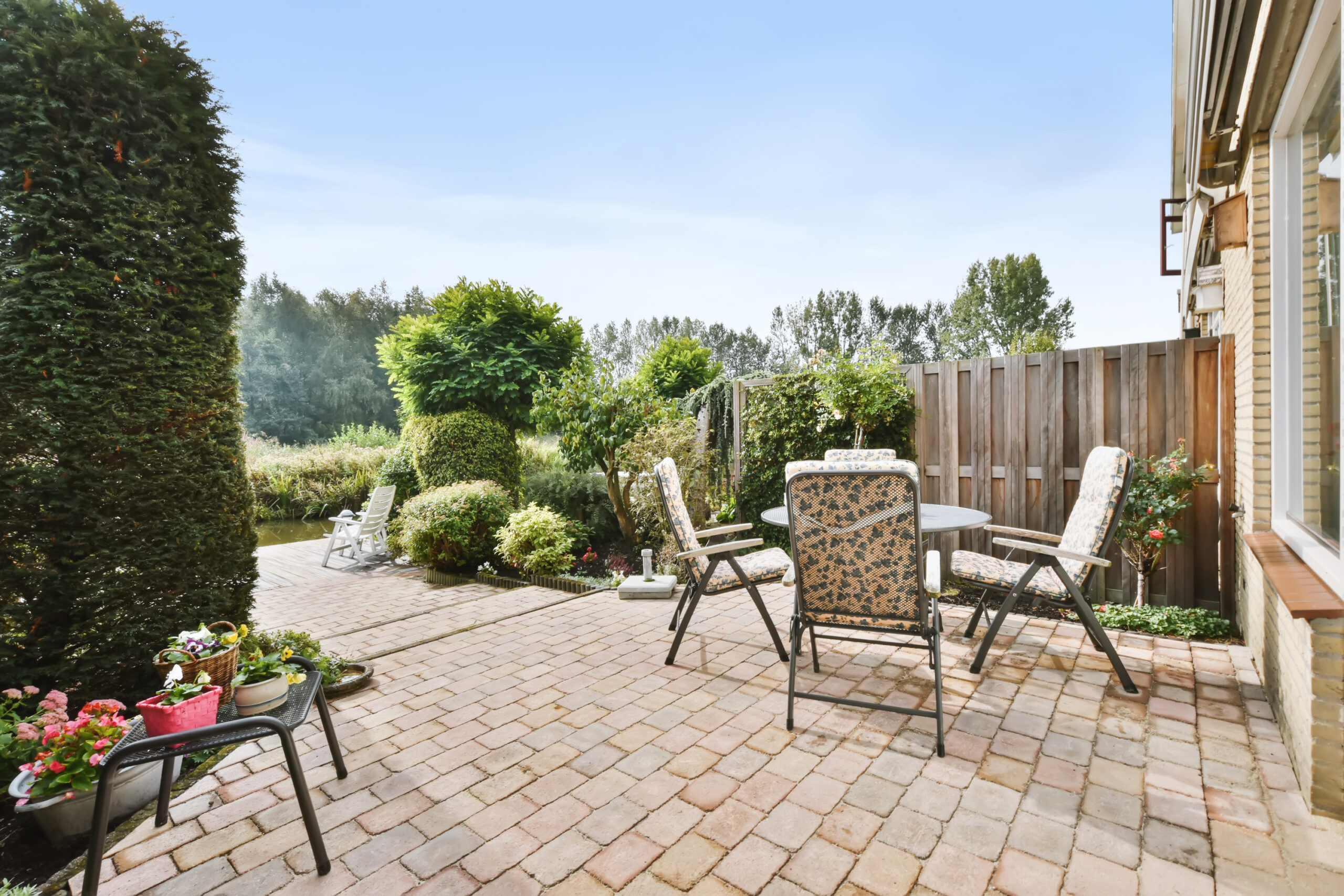
Standard-grade concrete pavers represent the entry tier, typically running $3 to $6 per square foot in material cost before installation labor. These units offer solid freeze-thaw performance and dimensional consistency but come in a more limited range of colors, textures, and shapes compared to higher tiers. For homeowners prioritizing budget and reliable performance over design flexibility, standard-grade pavers deliver a durable result at the lowest material cost point.
Mid-tier tumbled or textured pavers run higher, generally $6 to $10 per square foot in material cost, reflecting the additional manufacturing process that gives them a weathered, less uniform surface appearance. This tier suits homeowners who want a softer, more traditional look than standard pavers provide without moving into premium pricing. Properties throughout Cornell Heights and Forest Home, where homes often have traditional architectural character, frequently land in this tier for a patio that complements the existing aesthetic.
Premium and large-format pavers, including thicker dimensional units, multi-piece pattern sets, and specialty color blends, can run $10 to $18 or more per square foot in material cost alone. This tier includes products designed to mimic natural stone appearance closely while retaining the engineered freeze-thaw performance of manufactured concrete. For patios in highly visible locations or where a distinctive design statement is the priority, this tier delivers that result, at a meaningfully higher material cost.
Permeable paver systems, which allow water to drain through the surface rather than running off, occupy their own cost category, generally running toward the upper-mid to premium range due to specialized unit design and the different base specification these systems require. On Ithaca properties with significant drainage challenges, the functional benefit can justify the added cost, though this is a more specialized application than most residential patio projects need.
Labor and Base Preparation: The Majority of Your Cost
Base preparation and labor typically represent 55 to 65 percent of total paver patio project cost in Ithaca, which often surprises homeowners who assumed the pavers themselves would be the primary expense. This is the portion of the project that determines whether the patio holds up through Ithaca winters, and it’s also the portion that’s easiest to underestimate when comparing quotes.
Excavation depth in Ithaca’s climate needs to extend well beyond what mild-climate installation guides recommend, due to frost penetration and the moisture-retentive characteristics of the area’s clay-heavy soils. A properly built paver base typically requires significantly more excavation, gravel hauling, and compaction labor than a four to six inch base would, and that additional work shows up directly in the labor portion of a quote.
Site access affects labor time in ways that vary significantly between properties. A patio project on a property in Downtown Ithaca with limited side-yard access and no direct equipment route to the backyard requires material to be moved by hand over a longer distance than a property with a wide driveway leading directly to the work area. That access difference can add measurable labor hours to projects that are otherwise similar in size and material specification.
Grade and drainage planning add labor time on properties with any slope or uneven terrain across the patio footprint. Establishing proper pitch away from the house, accounting for water flow across the broader property, and integrating the patio elevation with adjacent lawn or hardscape all require careful grading work before any base material goes down. Flat lots require less of this planning time than sloped properties throughout the hillier sections of the city.
Compaction technique is a labor-intensive step that directly determines long-term patio performance. Achieving proper density in the gravel base, particularly in the lifts required to reach adequate depth for Ithaca’s frost conditions, takes equipment time and an experienced operator. This is one of the steps most commonly shortened on lower-bid projects, and it’s also one of the most expensive mistakes to correct once a patio has settled unevenly.
Pattern, Jointing, and Finishing Add-Ons
Beyond core material and labor cost, several common choices shift a paver patio’s final price, and knowing what these add before getting quotes helps you compare apples to apples across different contractors.
Pattern complexity affects both material waste and labor time. A simple running bond or stack bond pattern requires minimal cutting and is the fastest layout to install, keeping costs toward the lower end of the range. Herringbone and basketweave patterns require more cuts at borders and transitions, typically adding 5 to 10 percent to material waste and increasing labor time for the additional fitting work involved. Multi-size or multi-color pattern combinations, sometimes called “modular” or “ashlar” layouts, add further complexity and cost due to the planning and precision required to execute the pattern correctly.
Polymeric sand jointing has become the standard choice over traditional sand for paver joints, and it adds a modest cost premium that’s generally worth the investment in Ithaca’s climate. Polymeric sand hardens after activation with water, resisting washout during heavy rain and reducing weed establishment in joints compared to standard sand. The cost difference is relatively small relative to total project cost but meaningfully reduces long-term joint maintenance.
Sealing is an optional finishing step that protects paver color and surface from UV fading and staining, typically priced as a separate line item rather than included in base installation cost. Sealing isn’t strictly necessary for paver performance, since the pavers themselves are engineered for durability without it, but it does extend the time before fading becomes visible and can simplify cleaning. Some homeowners choose to seal at installation, while others wait a year to allow initial efflorescence, a natural mineral bloom on new concrete pavers, to resolve first.
Edge restraints, which anchor the paver field at its perimeter and prevent lateral shifting over time, are a necessary component rather than an optional add-on, but the type specified affects cost. Plastic restraints cost less than aluminum or steel options, though metal restraints hold their position better through Ithaca’s freeze-thaw cycling and are generally worth the modest additional cost for a patio expected to perform for decades.
Built-in features like a fire pit area, a seating wall, or a defined planting bed integrated into the patio footprint add their own cost beyond the flat paver installation rate, since each involves additional materials and labor beyond the standard surface work. These elements are often quoted separately during the same site visit so the full project scope is clear before work begins.
Why Ithaca-Area Paver Patio Costs Run Above National Averages
National pricing guides for paver patios often cite numbers that don’t match what Ithaca homeowners see in local quotes, and understanding why helps set realistic expectations before the first contractor conversation.
The Finger Lakes region’s compressed working season, roughly late April through mid-October, concentrates labor demand into about six months rather than the longer or year-round windows some milder climates offer. That concentration affects scheduling availability and contributes to pricing that reflects the realistic annual capacity of local crews rather than a spread-out, lower-intensity workload.
Frost depth and clay soil conditions require base preparation that exceeds the specifications in generic national installation guides. Where a milder, sandier-soil climate might call for a four to six inch base, Ithaca properties typically need eight inches or more of properly compacted material to perform reliably through repeated freeze-thaw cycling. That difference in required base depth translates directly into more excavation, more material, and more labor than national average pricing assumes.
Terrain variation throughout the city, from flat lots to properties with significant grade changes across neighborhoods like East Hill and South Hill, adds complexity that uniform, flat suburban developments elsewhere don’t typically present. Properties with these characteristics require additional grading, drainage planning, and sometimes specialized equipment that flatter regions don’t factor into their baseline pricing.
A quote that comes in well below the local range for a project with genuine site complexity is worth a closer look rather than an automatic acceptance, since it may reflect shortcuts in base depth or compaction that won’t show up as a problem until a season or two after installation.
Getting an Accurate Quote for Your Property
The most reliable way to get an accurate number for how much your paver patio will cost is a site visit, not a phone estimate or an online calculator based on square footage alone. Soil type, drainage patterns, access, and grade all affect labor cost in ways that simply aren’t visible without seeing the actual property.
Ask for an itemized breakdown rather than accepting a single bottom-line number. A quote that separates material cost, base preparation, and any add-ons like polymeric sand or sealing gives you the ability to compare contractors meaningfully and to understand exactly what you’re paying for at each stage of the project.
Confirm what base depth the quote assumes. Given how much base preparation drives total cost in Ithaca’s climate, a quote that doesn’t specify base depth or that assumes a shallower depth than local conditions require may look attractive initially but carries real risk of underperformance. This is one of the most important questions to ask before signing any contract.
Discuss timeline alongside cost. Because Ithaca’s installation season is compressed, the price you’re quoted in February for a May installation may differ from a quote requested in June for the same scope of work, depending on how booked a contractor’s schedule has become. Getting quotes early in the planning process, even months before you intend to start, gives you the clearest picture of both cost and availability.
If your project includes adjacent areas that need attention, such as lawn restoration after construction or planting beds bordering the new patio, coordinating that work with professional landscape maintenance planning during the same site visit often produces a more accurate combined estimate. For broader hardscape elements like walkways or retaining walls connected to your patio project, reviewing the full scope through hardscape and stonework gives you a complete picture before committing to any single piece of the project.
When you’re ready to get a real number for your property, VP Designs Lawn & Landscape serves homeowners throughout Ithaca, New York and the surrounding areas with paver patio installation priced according to actual site conditions. Call (607) 592-5505 or visit the contact page to schedule a site visit and find out exactly how much a paver patio costs for your specific property.
Frequently Asked Questions About How Much a Paver Patio Costs
Q: What is the average cost per square foot for a paver patio in Ithaca, NY?
A: Most paver patio projects in the Ithaca area cost between $18 and $35 per square foot installed, with standard projects typically landing in the $22 to $30 range. Paver grade, pattern complexity, and base depth requirements all affect where a specific project falls within that range. A site visit produces the only reliable number for a given property.
Q: Why do paver costs vary so much between contractors for similar-sized patios?
A: Differences usually come down to base depth specifications, paver grade, and what’s included in the quote. A contractor specifying a shallower base than Ithaca’s frost conditions require can offer a lower price that doesn’t reflect what the patio actually needs to perform long-term. Asking for an itemized breakdown that specifies base depth helps you compare quotes meaningfully.
Q: Does paver pattern choice significantly affect total cost?
A: Yes, though usually by a moderate rather than dramatic margin. Simple running bond patterns keep costs lower due to minimal cutting waste and faster installation. Herringbone, basketweave, and multi-size modular patterns typically add 5 to 10 percent to material waste plus additional labor time for the more involved fitting work these patterns require.
Q: Is it worth paying more for premium pavers versus standard-grade units?
A: It depends on priorities. Standard-grade pavers offer solid freeze-thaw performance at the lowest material cost. Premium and large-format options provide a more distinctive appearance and sometimes a more natural-stone-like aesthetic, at a meaningfully higher material cost. Since base preparation cost is identical regardless of paver grade, the decision largely comes down to budget and the visual result you want for your specific property.
Q: How much does base preparation add to a paver patio’s total cost in Ithaca?
A: Base preparation and labor typically represent 55 to 65 percent of total project cost, more than the pavers themselves in most cases. Ithaca’s clay soils and significant frost depth require excavation and compacted gravel base well beyond what national installation guides recommend, and that additional excavation and material cost is reflected directly in local pricing.
Q: Should I seal my paver patio, and does it add much to the cost?
A: Sealing is optional rather than required for paver performance, since the pavers are engineered for durability without it. It does help slow UV fading and simplify cleaning over time. The cost is relatively modest compared to total installation cost and is typically quoted as a separate line item, with some homeowners choosing to wait about a year after installation before sealing to allow initial efflorescence to resolve.
Q: What size paver patio fits a typical budget for an Ithaca homeowner?
A: A modest 200 square foot patio using standard to mid-tier pavers in a simple pattern, at $22 to $28 per square foot, lands in the $4,400 to $5,600 range before any add-ons. Larger patios, premium materials, or complex patterns and built-in features push that total higher. A site visit clarifies what specific combination of size and material fits a given budget for your property.
Conclusion
How much a paver patio costs in Ithaca reflects a combination of paver grade, pattern complexity, base preparation requirements, and site-specific labor factors that vary meaningfully from property to property. The $18 to $35 per square foot range isn’t an arbitrary spread; it represents real variation in what different projects actually require, and understanding the components behind that range helps you evaluate any quote with genuine confidence.
The patios that perform well through years of Ithaca winters are the ones where base depth and compaction got the attention the climate demands, regardless of which paver grade sits on top. When comparing quotes, ask about base specifications and what’s included at each stage before focusing on the bottom-line number. That approach tells you far more about long-term value than price alone ever will.