
Choosing Walkway Stone That Survives a Finger Lakes Winter
Not all stone performs equally in Ithaca’s climate. A material that looks beautiful in a showroom or a landscaping magazine from a warmer region can chip, crack, shift, or deteriorate within a few winters here if it wasn’t the right choice to begin with. The freeze-thaw cycles that run from November through early April put real mechanical stress on walkway surfaces and the base beneath them, and the clay-heavy soils that dominate most Ithaca residential lots compound that stress by holding moisture and shifting as ground temperatures change.
Homeowners in Cayuga Heights replacing aging front walkways and those in Fall Creek designing new paths through established cottage gardens face the same core question: which stone is right for this project, this climate, and this property? The different types of stone for walkways vary significantly in durability, texture, installation requirements, and long-term maintenance demands. This article walks through the most common options, explains how each performs in Ithaca conditions, and covers what makes installation quality the deciding factor regardless of which material you choose.
Key Takeaways
- The different types of stone for walkways include flagstone, bluestone, granite, limestone, fieldstone, and concrete pavers, each with distinct performance profiles in Ithaca’s climate.
- Freeze-thaw durability and low water absorption are the most important material characteristics for walkways in the Finger Lakes region.
- Base preparation is more critical than stone selection; even the best material will shift and crack on an inadequate base through Ithaca winters.
- Bluestone and granite are among the most reliable performers in cold, wet climates, while softer limestones and certain sandstones carry more risk in this region.
- Walkway installation in Ithaca typically runs $18-$35 per square foot, with material choice and base complexity driving where a project lands in that range.
- The installation window in Ithaca runs late April through mid-October, and working within that window allows proper base compaction and material setting before ground freeze.
Understanding the Different Types of Stone for Walkways
The different types of stone for walkways fall into two broad categories: natural stone quarried from the earth and manufactured concrete pavers designed to mimic natural material. Each category contains multiple options with different textures, colors, absorption rates, and freeze-thaw performance records. Understanding those differences before selecting a material saves money, prevents installation failures, and produces a walkway that looks good and holds its footing for decades.
Natural stone brings character, variation, and a connection to the landscape that manufactured products struggle to replicate convincingly. Manufactured pavers offer dimensional consistency, easier installation, and predictable performance across a wider range of conditions. Neither is universally superior; the right choice depends on the style of the property, the demands of the specific application, and the installation approach backing it up.
VP Designs Lawn & Landscape helps Ithaca homeowners work through these decisions as part of every hardscape and stonework project. Material selection and base preparation are evaluated together because they are equally responsible for the long-term outcome of any walkway installation.
Flagstone: Character and Versatility
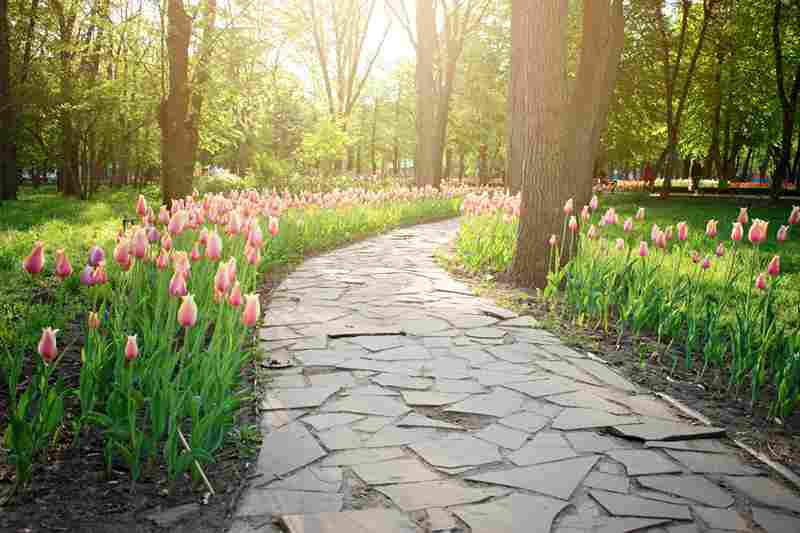
Flagstone refers to a category of flat-split natural stone used in irregular or cut patterns to create walkways, patios, and garden paths. Common flagstone varieties include bluestone, limestone, sandstone, and slate, each with different color ranges and performance profiles. The term flagstone describes the cut format rather than a specific rock type, which is why specifying the actual stone species matters when evaluating options for Ithaca’s climate.
Irregular flagstone, where pieces are laid in a natural, puzzle-style pattern with planted or gravel joints, suits the informal character of many Ithaca residential properties particularly well. Fall Creek properties with established perennial gardens and informal landscape character are a natural fit for irregular flagstone paths that feel organic rather than constructed. The variation in joint width and stone shape gives these walkways a lived-in quality that formal cut stone cannot replicate.
Cut or dimensional flagstone, where pieces are trimmed to consistent shapes and laid in a more formal pattern, suits properties with structured gardens, formal entrances, and architectural detail that calls for tighter lines. Both formats require a properly compacted base and appropriate joint material to perform through Ithaca winters. The stone itself is only as good as what’s underneath it.
Bluestone: The Workhorse of Northeast Walkways
Bluestone is one of the most commonly specified materials for walkways in the Northeast, and for good reason. It is a dense, low-absorption sandstone quarried extensively in New York and Pennsylvania that handles freeze-thaw cycling better than most natural alternatives. Its characteristic blue-gray color complements both traditional and contemporary architecture, and it takes well to both irregular and cut formats.
Thermal bluestone, which has a natural cleft surface texture, provides better traction than a sawn or honed finish, making it a practical choice for Ithaca walkways that will see winter foot traffic even after ice treatment. The texture also hides minor surface wear better than smoother finishes over time. Sawn bluestone with a smoother face works well for formal applications but becomes more slippery when wet or icy, which warrants careful consideration given Ithaca’s winter conditions.
Bluestone holds up well under the salting and calcium chloride treatments that Ithaca walkways typically receive through the snow season, which is not true of all natural stones. Some limestones and softer sandstones are vulnerable to surface erosion from de-icing chemicals applied season after season. Choosing a material that tolerates winter treatment without degrading is an important part of the selection conversation, and it connects directly to how the walkway will be maintained through the winter months. Pairing a quality stone walkway with proper snow and ice management keeps the surface clear without damaging it.
Granite: Maximum Durability for High-Traffic Applications
Granite is the most durable natural stone option for walkways and performs exceptionally well in cold, wet climates. It has an extremely low water absorption rate, which means freeze-thaw cycling has minimal effect on the surface compared to more porous materials. Granite cobblestones, pavers, and cut slabs are all used in walkway applications, each with a different visual character and price point.
Granite cobblestones create a traditional, textured surface well suited to entry approaches and garden paths where a historic or Old World character fits the property. They require careful installation with tight, stable joints to prevent rocking and shifting, and the uneven surface demands more attention from walkers than a flat flagstone or paver surface. For properties in Ithaca with older architectural character and formal landscape approaches, granite cobbles can be a strong design choice when installed correctly.
Granite pavers and cut slabs offer the durability of the material in a flatter, more accessible format. Gray granite reads similarly to bluestone in many applications but carries a higher material cost. For clients who want the absolute longest-lasting natural stone option and are willing to pay the premium, granite delivers on that expectation. It is also highly resistant to the surface etching that some de-icing chemicals cause on softer stones, which matters for a material that will see decades of Ithaca winters.
Limestone, Fieldstone, and Local Character Materials
Limestone is a softer sedimentary stone that offers warm tan and buff tones that suit naturalistic landscapes and informal garden settings. It is popular in warmer regions but requires more careful evaluation for Ithaca applications. Dense, hard limestone from quality quarries performs reasonably well in cold climates. Lower-density limestone, which is more porous and softer, absorbs more water and is more vulnerable to freeze-thaw spalling over time. The specific product source matters more with limestone than with harder stones like bluestone or granite.
Fieldstone, which refers to stone gathered from local fields and quarried outcrops, has deep historical roots in Upstate New York’s built landscape. Old fieldstone walls and paths are part of the visual character of the region, and incorporating fieldstone into new walkway projects connects a property to that history. Fieldstone is highly variable in shape, size, and density, which means working with it requires an experienced installer who can select and orient pieces for both stability and appearance. It suits informal paths and rural properties more naturally than formal entrance applications.
Local shale, which occurs naturally throughout the Ithaca area, is occasionally used in informal path applications but is generally not recommended for primary walkways. Shale splits and flakes under freeze-thaw stress and foot traffic and lacks the durability of purpose-quarried walkway stone.
Concrete Pavers: Consistency and Predictable Performance
Manufactured concrete pavers are not natural stone, but they warrant inclusion in any honest comparison of different types of stone for walkways. Modern concrete pavers are engineered to meet specific compressive strength and absorption standards, and the better products perform very well in freeze-thaw climates. They come in a wide range of profiles, colors, and textures, including formats that closely mimic the appearance of natural stone at a lower material cost.
The consistency of manufactured pavers simplifies installation, reduces waste, and makes future repairs straightforward since replacement units match the existing field exactly. A natural stone walkway that needs a section replaced may require careful matching that adds time and cost. Concrete pavers eliminate that variable. For homeowners who prioritize long-term maintainability and a clean, uniform appearance over the organic character of natural stone, concrete pavers are a practical and durable choice.
The criticism leveled at concrete pavers is that they can look constructed in a way that natural stone does not. This is a legitimate aesthetic consideration, not a performance one. In contemporary landscapes and modern architectural settings, concrete pavers often read as the better fit. In older Ithaca neighborhoods with established character, natural stone tends to suit the surroundings more naturally.
Base Preparation: The Factor That Determines Everything
The stone you choose for a walkway matters less than how it is installed. Every walkway failure in Ithaca, cracked slabs, shifted pavers, heaved sections, and sunken joints, traces back to base preparation. The base needs to be excavated to the right depth, filled with compacted gravel, and graded to direct water away from the surface and the foundation. In Ithaca’s clay soil, that drainage function is critical because clay holds water rather than draining it naturally.
A standard residential walkway installation requires excavating four to six inches of native soil, replacing it with compacted gravel base material, and setting a bedding layer appropriate to the stone format being installed. Cutting the excavation depth to save time or using inadequate base material produces a walkway that looks fine the first year and shifts progressively through subsequent winters. Two or three freeze-thaw seasons on an inadequate base can move a walkway far enough that it requires full removal and reinstallation to correct.
Professional installation from a crew familiar with Ithaca’s clay soils and winter conditions consistently produces better long-term outcomes than DIY approaches that underestimate base requirements. Walkway installation in this market runs $18-$35 per square foot installed, with material choice and site complexity driving placement in that range. That investment is protected by correct base construction and undermined without it. Understanding the full scope of what quality professional landscape maintenance includes helps homeowners see how walkway care fits into long-term property management.
Seasonal Timing for Walkway Installation in Ithaca
The practical installation window for stone walkways in Ithaca runs late April through mid-October. Ground temperatures need to be above freezing for proper compaction and bedding layer preparation. Installing on frost-softened or frozen ground produces a base that settles unevenly once temperatures stabilize in spring, which means sections shift and joints open before the first full season is even complete.
Late spring and early summer are the most favorable months for most walkway projects. The ground is workable, schedules are more flexible before peak season demand builds, and the installation has the full warm season to settle before facing its first winter. Fall installations are possible and can work well when completed by mid-October, but the window closes quickly once overnight temperatures begin dropping consistently below freezing. Pairing a new walkway with a complete property services plan that includes seasonal maintenance and winter ice management gives the installation the best possible long-term outcome.
If you’re sorting through the different types of stone for walkways and want guidance on what makes sense for your specific Ithaca property, VP Designs Lawn & Landscape serves Ithaca, New York and the surrounding areas with hardscape installation built around the real demands of this climate. Call (607) 592-5505 to schedule a site visit and discuss material options, base requirements, and what a walkway project would involve for your property. You can also reach out through our contact page to start that conversation before the season fills up.
Frequently Asked Questions About Different Types of Stone for Walkways
Q: What are the best different types of stone for walkways in Ithaca’s climate?
A: Bluestone and granite are the strongest performers in Ithaca’s freeze-thaw conditions. Both have low water absorption rates that resist the freeze-thaw spalling that damages more porous materials. Bluestone is widely available from regional quarries and handles de-icing chemicals well. Granite offers maximum durability at a higher price point. Dense concrete pavers are also a reliable option when natural stone aesthetics aren’t the priority.
Q: How much does stone walkway installation cost in Ithaca?
A: Stone walkway installation in Ithaca typically runs $18-$35 per square foot installed. Material choice, base complexity, and walkway length and shape all affect where a project lands in that range. Natural stone at the premium end and properties requiring significant excavation or grading work push toward the higher end. Getting a site-specific quote is the most reliable way to budget accurately.
Q: Can I install a stone walkway myself to save money?
A: For short, informal garden paths using irregular fieldstone or stepping stones on flat ground, DIY installation is manageable. For primary entrance walkways, any application near a foundation, or projects involving cut stone or formal patterns, professional installation produces significantly better outcomes. Base preparation errors are the most common DIY failure point, and correcting a shifted walkway after two or three Ithaca winters costs more than professional installation would have.
Q: Does the type of stone affect how I treat it for ice in winter?
A: Yes. Bluestone and granite tolerate most de-icing products well. Softer limestones and certain sandstones are vulnerable to surface erosion from repeated salt and calcium chloride application. If your walkway material is on the softer end, calcium chloride at appropriate concentrations is gentler than rock salt. Discussing material selection and winter treatment together at the planning stage prevents surface damage that builds up over multiple seasons.
Q: How long does a properly installed stone walkway last in Ithaca?
A: A stone walkway installed on a properly compacted and drained gravel base using a quality material like bluestone or granite should last 25 to 40 years or more with normal maintenance. The limiting factor is almost always base failure rather than the stone itself. Walkways that heave, shift, or crack within the first five to ten years almost universally trace back to inadequate base depth or drainage, not the material that was chosen.
Q: What is the difference between flagstone and bluestone?
A: Flagstone describes a flat-split format used for paving, while bluestone is a specific rock type, a dense sandstone quarried in New York and Pennsylvania, that is often cut into flagstone format. Bluestone is one of the most common flagstone materials used in the Northeast, but flagstone can also refer to limestone, slate, quartzite, or other flat-split stones. When someone says flagstone, clarifying the actual stone species is important for understanding how it will perform in Ithaca’s climate.
Q: When is the best time to install a stone walkway in Ithaca?
A: Late April through mid-October is the practical installation window. Late spring is generally ideal since the ground is fully thawed and workable, schedules are more accessible before peak demand builds, and the finished walkway has the full growing season to settle before its first winter. Fall installations work when completed well before mid-October, but they need to finish before consistent overnight freezes begin to ensure proper base compaction.
Conclusion
Selecting the right stone for a walkway in Ithaca comes down to two things: choosing a material with the freeze-thaw durability this climate demands and making sure it gets installed on a base that actually supports it through decades of Finger Lakes winters. Bluestone and granite lead the field for performance. Flagstone in quality stone species delivers character alongside durability. Concrete pavers offer consistency and long-term maintainability. The material decision matters, but the installation decision matters more.
A walkway that is built correctly from the ground up, with the right depth, the right gravel, and the right drainage, will look good and hold steady for a very long time regardless of which stone ends up on top. A walkway built on shortcuts will show you those shortcuts within a few winters no matter how beautiful the stone is. Getting the base right is the investment that protects everything visible above it.